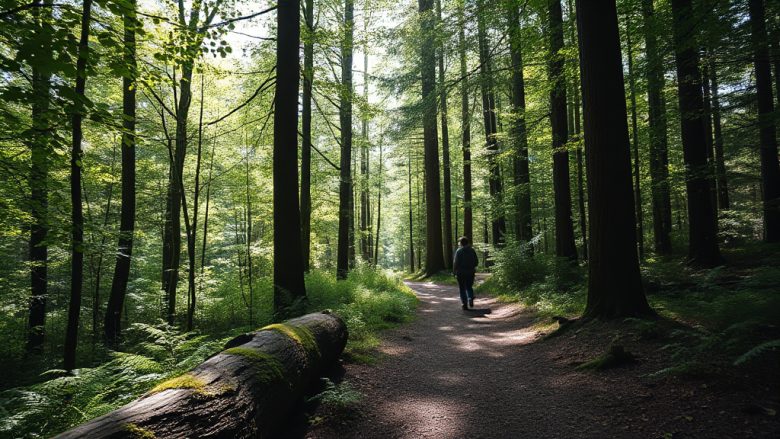
Forest bathing is not a hike and not a bath. It is a slow, sensory walk in green space, usually lasting twenty minutes to two hours, where the point is to notice rather than to cover distance. If you have heard the term and wondered whether it is a real practice or just a wellness buzzword, this explainer covers everything you need to know about forest bathing: where it comes from, what actually happens during a session, what the research does and does not support, and how to try a thirty-minute version in a local park this week.
Where forest bathing comes from
The practice is Japanese, and the phrase most people use is a direct translation of shinrin-yoku. It emerged in the early 1980s, when Japan’s forestry agency was looking for ways to reconnect an increasingly urban population with the country’s woodlands. The timing was not accidental. Japan had gone through decades of rapid industrial growth, and public health officials were worried about the stress load of city life. Walking in forests was cheap, accessible and culturally familiar. It did not need equipment, a membership or a belief system.
What made shinrin-yoku different from ordinary walking was the instruction to slow down. Early promoters encouraged people to engage all five senses, to sit, to breathe, to listen. There was no summit to reach and no step count to hit. The forest was the destination, not the route to somewhere else.
The idea travelled. By the 2000s it had picked up interest in South Korea, where the government invested in healing forests and trained forest therapy guides. It reached Europe and North America more slowly, first through academic circles and then through wellness culture, where it sometimes got flattened into “a walk in the woods” or, worse, sold as a cure for everything. The original practice is more modest than either version. It is a structured way of paying attention outdoors, and its benefits are mostly the ordinary benefits of slowing down, moving gently and being somewhere green.
What actually happens in a session
A session is less eventful than the name suggests. You go to a place with trees. You walk slowly. You stop often. You might sit for ten minutes and do nothing in particular. That is roughly it.
Guides often open with a grounding exercise: standing still, feeling your feet, taking a few slow breaths. Then the walk begins, usually at a pace that feels almost uncomfortably slow at first. The instruction is to let your attention rest on whatever is actually present, rather than on your to-do list. The smell of damp earth after rain. The way light moves through leaves. The sound of wind in different canopies. The temperature change when you step into shade. The texture of bark or moss, if you are willing to touch it.
There is no performance involved. You are not trying to identify every tree or achieve a meditative state. If your mind wanders, you bring it back to something you can sense. That is the whole technique.
Group sessions sometimes include a guided invitation, such as walking in silence for ten minutes or finding one thing that catches your eye and staying with it. Solo sessions can be simpler: a timer, a route you know, and a commitment to leave your phone in your pocket. Either way, the structure matters less than the pace. A forest bath done at hiking speed is just a hike.
What the science does and does not show
This is where honesty is needed, because forest bathing attracts more claims than the evidence can carry.
What is reasonably well supported is that spending time in natural environments is associated with lower self-reported stress, improved mood and better attention. Studies have measured things like heart rate variability, blood pressure and levels of cortisol, a stress hormone, before and after time in green space. Many of these studies are small, and some are hard to blind, since participants obviously know whether they are in a forest or a laboratory. That does not make the findings worthless. It does mean they should be read as encouraging rather than definitive.
The more colourful claims are the ones to treat with caution. You may have read that trees release airborne compounds called phytoaorticides, or that forest air contains chemicals that boost natural killer cells, a type of immune cell. There is some research in this area, mostly from Japan, but it is preliminary and the effect sizes are uncertain. It is also not clear how much of any benefit comes from the chemicals, how much from the walking, how much from the quiet, and how much from simply being away from screens and traffic. The honest summary is that forest bathing probably helps, that the mechanism is likely a mix of things, and that nobody has isolated a single magic ingredient.
What the research does not support is the idea that forest bathing replaces medical treatment. It is not a therapy for clinical depression, anxiety disorders or chronic illness in the way that medication or talking therapy is. It is a low-risk, low-cost activity that most people can add to their lives alongside whatever else they are doing. Think of it as a support, not a solution.
Common misconceptions
The biggest one is that you need a forest. You do not. The practice works in any green space with enough trees to change the atmosphere: a city park, a canal towpath lined with willows, a cemetery, a university campus, a patch of woodland at the edge of a housing estate. The quality of attention matters more than the grandeur of the setting. A quiet corner of a local park on a weekday morning can be more restorative than a crowded trail in a national park.
Another misconception is that it requires a guide, a group or a course. Guided sessions can be lovely, especially if you find it hard to slow down on your own, but the practice is designed to be done alone and for free. You do not need special clothing, a mat or an app. Comfortable shoes and a willingness to be a bit bored for the first ten minutes are enough.
People also assume it must take hours. It does not. A meaningful session can be half an hour, including travel time. The benefits seem to come from regularity more than duration. Three short walks a week will likely do more for you than one long excursion a month.
Finally, there is the misconception that forest bathing is about escaping your problems. It is not. You will still have the same job, the same bills and the same difficult email waiting when you get back. What changes is your capacity to deal with them. That is a smaller promise than the wellness industry likes to make, but it is a more reliable one.
How to do a thirty-minute session in a local park
Pick a green space you can reach in ten minutes or less. Familiarity is fine. In fact, it helps, because you spend less time navigating and more time noticing. Go at a time when it is likely to be quiet, if you can. Early morning and late afternoon are usually good.
Leave your headphones at home and put your phone on silent. Set a timer for thirty minutes so you are not checking the clock. Walk at roughly half your normal pace. When you notice yourself speeding up, slow down again. Stop whenever something catches your attention, and stay with it for a minute or two rather than taking a photo and moving on.
A simple way to structure the time is to give each sense a turn. Spend five minutes on what you can see, five on what you can hear, five on what you can smell, five on what you can feel, and the last ten on nothing in particular, just walking and letting your attention settle wherever it wants. If that feels too rigid, ignore it. The only rule is that you are not trying to get anywhere.
Afterwards, notice how you feel without grading it. You might feel calmer. You might feel nothing much. Both are normal. The point is not to chase a peak experience but to build a habit of stepping out of the day’s noise and into somewhere green. Do it once this week, then again next week. That is everything you need to know about forest bathing to start, and starting is the only part that actually matters.